Monday, 11 May 2009

Sunday, 10 May 2009
Wednesday, 6 May 2009


Tuesday, 5 May 2009
Tuesday, 21 April 2009
curiosities galore


http://brblroom26.wordpress.com/2008/04/11/oratorical-gestures/
tis a pretty good website,
has documental photographs of
poets
playing cards
and other such things
tis a pretty good website,
has documental photographs of
poets
playing cards
and other such things


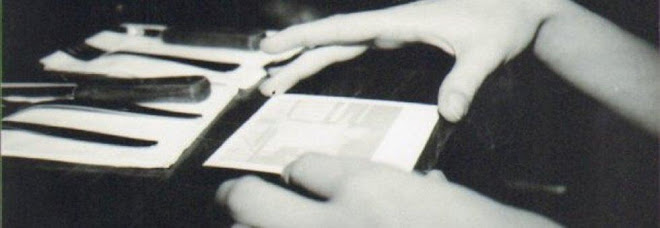
Herbert Distel
Herbert Distel adopted the role of the museum curator when he invited artists from around the world to contribute miniature works for display in the tiny "galleries" of his Museum of Drawers. The drawers in this found cabinet are filled with five hundred works by a wide range of artists, some well known, like Picasso, others obscure, creating a comprehensive survey of artistic currents in the 1960s and 1970s. According to Distel, "Museums, especially museums of fine art, are places where we become conscious of time. Like a preserving jar, they have the task of conserving and presenting a subject curdled with time--the artwork. But through and behind these works the artists appear, falling out of the screen of time, as it were, and become immortal."

Cabnet of curiosities


Cabinets of curiosities (also known as Wunderkammer, Cabinets of Wonder, or wonder-rooms) were encyclopedic collections of types of objects whose categorical boundaries were, in Renaissance Europe, yet to be defined. Modern science would categorize the objects included as belonging to natural history (sometimes faked), geology, ethnography, archaeology, religious or historical relics, works of art (including cabinet paintings) and antiquities. "The Kunstkammer was regarded as a microcosm or theater of the world, and a memory theater. The Kunstkammer conveyed symbolically the patron's control of the world through its indoor, microscopic reproduction."[1] Of Charles I of England's collection, Peter Thomas has succinctly stated, "The Kunstkabinett itself was a form of propaganda"[2] Besides the most famous, best documented cabinets of rulers and aristocrats, members of the merchant class and early practitioners of science in Europe, formed collections that were precursors to museums.
Taken from wikipedia
Taken from wikipedia


Newton’s laws of motion
First law
There exists a set of inertial reference frames relative to which all particles with no net force acting on them will move without change in their velocity. This law is often simplified as "A body persists its state of rest or of uniform motion unless acted upon by an external unbalanced force."
Second law
Observed from an inertial reference frame, the net force on a particle of constant mass is proportional to the time rate of change of its linear momentum: F = d(mv)/dt. This law is often stated as, "Force equals mass times acceleration (F = ma)": the net force on an object is equal to the mass of the object multiplied by its acceleration.
Third law
Whenever a particle A exerts a force on another particle B, B simultaneously exerts a force on A with the same magnitude in the opposite direction. The strong form of the law further postulates that these two forces act along the same line. This law is often simplified into the sentence, "To every action there is an equal and opposite reaction.”
From Wikipedia
Subscribe to:
Posts (Atom)
